
.png)
Restorative

.jpg "Rosangel Oropeza, DDS photo")
Rosangel Oropeza, DDS
PGY-2 Pediatric Dentistry Resident
University of Texas — Houston, Houston, TX
University of Texas Health Science Center, Houston
Houston, California, United States
Leticia Chaves de Souza, DDS, MS, PhD
University of Texas Health Science Center at Houston School of Dentistry
Ryan Quock, DDS
University of Texas Health Science Center at Houston School of Dentistry
Di (Ivy) Wu, DDS, MS, PhD
University of Texas Health Science at Houston School of Dentistry
Lubna Fawad, DDS
University of Texas Health Science Center at Houston School of Dentistry
Juliana Barros, DDS, MS
Associate Professor & Vice Chair, Department of Restorative Dentistry & Prosthodontics
University of Texas Health Science Center at Houston School of Dentistry
Houston, Texas, United States

Brett T. Chiquet, DDS, PhD
Associate Professor Non-Tenure Clinical
University of Texas Health Science Center at Houston School of Dentistry
University of Texas School of Dentistry
Houston, Texas, United States
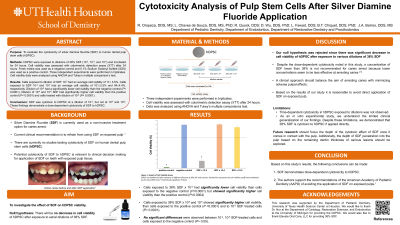
Purpose: The purpose of this study is to evaluate the cytotoxicity of silver diamine fluoride (SDF) to human dental pulp stem cells (DPSC).
Methods: Human dental pulp stem cells were exposed to different dilutions of 38% SDF (10-3, 10-4, and 10-5) and incubated for 24h. Cell viability was assessed with colorimetric detection assay (XTT) at 24h. Fresh media was used as a negative control and 0.1% Sodium Dodecyl Sulfate (SDS) was used as a positive control. Dilution experiments were done in triplicates and in two independent reactions. Cytotoxicity data was analyzed using ANOVA and Turkey’s multiple comparison’s test.
Results: Cells exposed to a dilution of SDF 10-3 had an average cell viability of 17%. Cells exposed to SDF 10-4 and 10-5 had an average cell viability of 101% and 94%, respectively. Significant differences were noted between dilutions of SDF. SDF was cytotoxic to cells at 10-3, but not at 10-4 or 10-5 after 24h (P < .0001).
Conclusions: SDF was cytotoxic to human dental pulp stem cells at 10-3, but not at further dilutions of 10-4 and 10-5. These findings demonstrate the cytotoxic capacity of highly concentrated SDF on dental pulp stem cells. At much lower concentrations it seems like SDF loses its cytotoxic effect. These results may contribute to further studies on SDF toxicity based on different amounts of remaining dentin thickness.