
.png)
Caries


JungSoo Kim, DDS
Pediatric Dental Resident
University of California, San Francisco
San Francisco, California, United States
Yihua Zhu, M.S.
University of California, San Francisco
Brent Lin, D.M.D.
University of California, San Francisco
Donald Curtis, D.M.D.
University of California, San Francisco
Daniel Fried, Ph.D.
Professor
University of California, San Francisco
San Francisco, California, United States
Daniel Fried, Ph.D.
Professor
University of California, San Francisco
San Francisco, California, United States
Thomas Tanbonliong, DDS
Program Director
University of California, San Francisco
San Francisco, California, United States
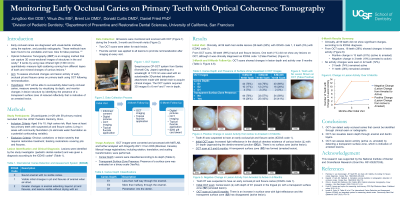
Purpose: To observe changes in the structure and activity of early occlusal caries on primary teeth using Cross-Polarization Optical Coherence Tomography (CP-OCT). The hypothesis is that CP-OCT will be able to successfully identify the presence of a transparent surface zone of reduced reflectivity that is indicative of remineralization and an arrested lesion.
Methods: Participants (n=29 with 59 primary molars) aged 6-10 years old with high caries risk participated in the study. All lesions were monitored over a 6-month period and scanned with CP-OCT during the 0-month, 3-month and 6-month visits. Fluoride varnish was applied to all lesions to promote remineralization. Images were converted and analyzed with image analysis software.
Results: OCT scans showed that 58 teeth (98%) had pit and fissure lesions. There were increasing number of teeth showing a distinct surface zone over 6 months (n=14 (24%) at 0-month, n=25 (43%) at 3-month, n=24 (42%) at 6-month). Out of all teeth with active lesions at 0-month, n=13 (30%) teeth developed a surface zone at 6-month. Out of all teeth with arrested lesions at 0-month, n=3 (21%) teeth became active and no longer showed a distinctive surface zone at 6-month.
Conclusions: OCT can detect early occlusal caries that cannot be identified on radiographs or through a clinical exam. It can provide information on lesion activity by detecting the presence of a transparent surface zone, indicative of lesion arrest. OCT is a valuable diagnostic tool that can aid with diagnosis of early occlusal caries.