
.png)
Caries


Tiffany E. Holcomb, DDS
Resident
University of California, Los Angeles, CA
Los Angeles, California, United States
Marcia Dinis, PhD
UCLA School of Dentistry
Nini Tran, n/a
University of California, Los Angeles, CA
Los Angeles, California, United States
Daniela R. Silva, DDS, MS
Program Director
UCLA
Los Angeles, California, United States
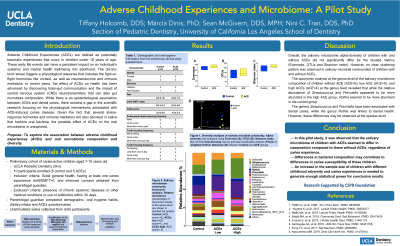
In our preliminary study, independent of caries status, we observed that the salivary microbiome of children with ACEs had higher diversity when compared to children without ACEs for the different studied metrics. The salivary microbial communities of children without ACEs are clustered separately from those with ACEs, indicating a possible distinct microbial composition between groups. In addition, the taxonomic analysis of the salivary microbiome revealed that the salivary microbiome of children with ACEs had a decrease in Streptococcus and Prevotella genus abundance compared to children without ACEs.
Purpose: This pilot study explores the link between adverse childhood experiences (ACEs) and dental caries in the pediatric population via the association of the ACEs scores and oral microbiome composition and diversity.
Methods: Parents of eligible children at the UCLA Children’s Dental Center completed consent and questionnaires accessing ACEs, demographics, oral hygiene habits, and dietary intake. Five children with ACEs and four children with no ACEs (gender and age-matched) were enrolled in the study. Child participants received comprehensive oral examinations and donated saliva samples. The salivary microbiome of the two groups was investigated by 16S rRNA gene sequencing, and downstream bioinformatics analysis was performed to compare the community composition and diversity.
Results:
Conclusion: Differences in microbial composition were observed between children with and without ACEs, which may contribute to differences in caries susceptibility of these children. Further investigation with an increase in sample size is needed to generate higher statistical power for conclusive results.