
.png)
Patient Management


Kathleen K. Nguyen, DDS
Pediatric Dental Resident
UCLA
UCLA School of Dentistry
Los Angeles, California, United States

Clarice S. Law, DMD, MS
Health Sciences Clinical Professor
UCLA School of Dentistry
UCLA School of Dentistry
Los Angeles, California, United States
Myung Sim, DrPH Biostatistics, MS Biostatistics
UCLA Division of General Internal Medicine and Health Services Research
Chloe Meyer, DDS
UCLA
Clarice S. Law, DMD, MS
Health Sciences Clinical Professor
UCLA School of Dentistry
UCLA School of Dentistry
Los Angeles, California, United States
Daniela R. Silva, DDS, MS
Program Director
UCLA
Los Angeles, California, United States
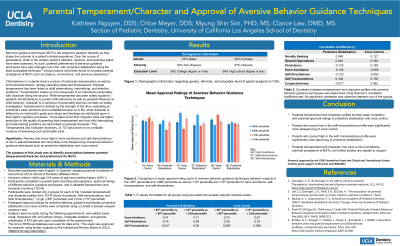
Purpose: The purpose of this study was to identify associations between parental temperament/character and preferences for BGTs. We hypothesize that parents who score high in harm avoidance and self-transcendence or low in self-directedness are more likely to be disapproving of aversive behavior guidance techniques such as protective stabilization and voice control.
Methods: Recruited participants were English- or Spanish-speaking parents of patients of record from UCLA School of Dentistry affiliated clinics. Inclusion criteria were: child’s age (3-8 years of age) and medical history (ASA I). Participants completed a questionnaire recording demographics, approval ratings of different behavior guidance techniques, and a validated temperament/character assessment (TCI-R). Participants were divided into 2 groups for each of the 3 studied temperament/character profiles from the TCI-R (Harm Avoidance, Self-transcendence, and Self-directedness): 1) high ( >85th percentile) and 2) low ( < 15th percentile). Participant approval ratings for aversive BGTs (protective stabilization and voice control) were compared using a 2-sided 2-sample unequal variance t-test.
Results: Preliminary data indicate no statistically significant differences between the >85th percentile group and the < 85th percentile group for approval of protective stabilization or voice control for either the Harm Avoidance, Self-transcendence, or Self-directedness profiles. Similarly, there were no statistically significant differences observed between the >15th percentile group and the < 15th percentile group for the same three temperament/character profiles.
Conclusions: The current preliminary conclusion suggests that there is no influence of parental Harm Avoidance, Self-transcendence, or Self-directedness on approval of aversive behavior guidance techniques. Factors other than temperament/character must be considered.