
.png)
Patient Management

J R. Wright, DDS
Resident
Geisinger Medical Center
Geisinger Pediatric Dentistry
Selinsgrove, Pennsylvania, United States
Gayatri Malik, DMD, PhD
Associate Program Director
Geisinger Medical Center
Danville, Pennsylvania, United States
Natalie Stinton, DMD
Program Director
Geisinger Medical Center, Department of Pediatric Dentistry
Danville, Pennsylvania, United States
Lacey Williams, DMD
Geisinger Medical Center
Gayatri Malik, DMD, PhD
Associate Program Director
Geisinger Medical Center
Danville, Pennsylvania, United States
Natalie Stinton, DMD
Program Director
Geisinger Medical Center, Department of Pediatric Dentistry
Danville, Pennsylvania, United States
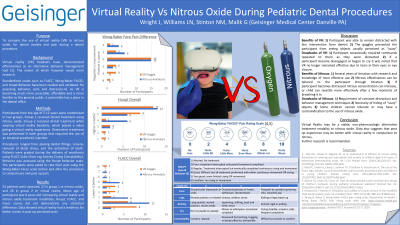
Purpose: To compare the use of virtual reality (VR) to nitrous oxide, for dental anxiety and pain during a dental procedure.
Methods: Participants from the age of 5-12 years were randomized in two groups. Group 1 received dental treatment using nitrous oxide. Group 2 received dental treatment while wearing virtual reality headsets, which played a video giving a virtual reality experience. Restorative treatment was performed in both groups that required the use of an intraoral anesthetic injection.
Procedures ranged from placing dental fillings, crowns, removal of distal shoes, and the extraction of teeth. Patients were graded during the delivery of anesthesia using FLACC Scale (Face Leg Activity Crying Consolability). Behavior was assessed using the Houpt behavior scale. The participants were asked to rate their pain using the Wong-Baker Faces scale before and after the procedure to compare pre and post op pain.
Results: 53 patients were assessed, 27 in group 1 or nitrous oxide, and 26 in group 2 or virtual reality. Mean age of participant was 8 years old. Comparing virtual reality and nitrous oxide treatment modalities, Houpt, FLACC, and Faces scores did not demonstrate any statistical difference. Data showed virtual reality had a tendency for better scores in post op perceived pain.
Conclusions: Virtual Realty may be a viable, non-pharmacologic alternative treatment modality to nitrous oxide. Data also suggests that post op experience may be better with virtual reality in comparison to nitrous.
Further research is recommended.