
.png)
Caries

Annie Herman Perel, DMD
PGY-2
Montefiore Medical Center
Montefiore Medical Center
New York, New York, United States
Nuntiya Kakanantadilok, DMD
Director of Residency Education, Division of Pediatric Dentistry
Montefiore Medical Center
Bronx, New York, United States
Nuntiya Kakanantadilok, DMD
Director of Residency Education, Division of Pediatric Dentistry
Montefiore Medical Center
Bronx, New York, United States
Alice Lee, DDS
Associate Director/Assistant Professor
Montefiore Medical Center
Bronx, New York, United States
Provider Perspectives on Silver Diamine Fluoride as a Modality of Treatment for Carious
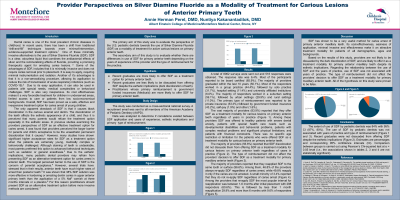
Lesions of Anterior Primary Teeth. Herman Perel A, Kakanantadilok N (Montefiore Health System/Albert Einstein College of Medicine, Bronx, NY) Purpose: The primary aim of this study was to evaluate the perspective of the U.S. pediatric dentists towards the use of Silver Diamine Fluoride (SDF) as a modality of treatment for active carious lesions on primary anterior teeth. The secondary aim of this study was to evaluate whether there are differences in use of SDF for primary anterior teeth depending on the years of experience from the provider and the type of reimbursement for the practice. Results: A total of 8062 surveys were sent out and 518 responses were obtained. The vast majority of providers (83.9%) reported that they offer SDF as a treatment modality for carious lesions on primary anterior teeth regardless of years in practice. The majority of providers (56.6%) reported that SDF discoloration did not dissuade them from offering SDF as a treatment modality for carious lesions on primary anterior teeth regardless of years in practice. The type of reimbursement did not affect the providers’ decision to offer SDF as a treatment modality for primary maxillary anterior teeth. The majority of providers reported that they reapplied SDF to the same tooth or surface (96.6%). Among them, 46.8% of the providers always re-apply SDF regardless of caries arrest, while 49.8% reapply it only if the caries are not arrested. A small minority of 3.4% reported that they do not re-apply SDF regardless of caries arrest. Among the providers that re-apply SDF the most popular interval for reapplication was between 1-6 months after initial placement with 298 responders (60.6%). This is followed by less than 1 month reapplication 29.9% and more than 6 months with 9.6% of responders.
Methods: The study was conducted as a cross-sectional national survey. A recruitment email was sent to all members of the American Academy of Pediatric Dentistry (AAPD).
Data was analyzed to determine if correlations existed between SDF application and years of experience, esthetic implications and primary type of reimbursement.
Conclusion: SDF has shown to be a very useful method for caries arrest of primary anterior maxillary teeth. Its cost-effectiveness, easiness of application, minimal invasive and effectiveness make it an attractive treatment modality for patients of all demographics, ages and backgrounds.
Based on the results of this study, providers are not likely to be dissuaded by the dark discoloration of SDF, and are likely to offer it as a treatment modality for primary anterior maxillary teeth despite its esthetic implications. Regarding the relationship between the use of SDF and the years of practice, use of SDF was not associated with years of practice. The type of reimbursement did not affect the providers’ decision to offer SDF as a treatment modality for primary maxillary anterior teeth. All of the hypothesis on this study were proven to be false.