
.png)
Patient Management

Vanessa L. Matamoros, DMD
Dental Resident
Nicklaus Children’s Hospital, Miami, FL
Nicklaus Children's Hospital
Davie, Florida, United States
Apeksha Gupta, MPH
Nicklaus children's Hospital
Paula Miranda, DMD
Attending
Nicklaus Children's Hospital, Doral, FL
Doral, Florida, United States
Paula Miranda, DMD
Attending
Nicklaus Children's Hospital, Doral, FL
Doral, Florida, United States
Oscar Arevalo, DDS, ScD, MS, MBA
Attending
Nicklaus Children Hospital, Doral, FL
Miami, Florida, United States
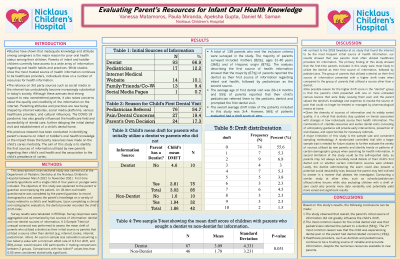
Purpose: To evaluate the association between decayed, missing, filled teeth (dmft) and source of information for infant oral-health among parents.
Methods: Parents with a single child of ≤4 years old completed a questionnaire administered during a dental examination at Nicklaus Children’s Hospital. The questions included demographics, child's oral hygiene, dietary habits, and frequency of dental visits. Variables were observed descriptively and an Analysis of Variance was performed comparing mean dmft-index as it related to sources of information used for infant oral-health, e.g. internet, family/friends, books/magazines, dentists, pediatricians). The statistical significance was set at P < .05.
Results: Of a total of 139 parents, most were mothers (82%), ages 31-40 years (36%) and Hispanic (87%). Most parents (67%) reported the dentist as their first source of information regarding infant oral health. The average age of first dental visit was 20±14 months and 55% of parents brought their child to a dentist based on pediatricians’ recommendation. The average dmft index was 3±4 and there was no significant difference observed in source of information and morbidity levels.
Conclusion: Healthcare providers, such as dentists and pediatricians, continue to be a trusting source of reliable and accurate information, despite the numerous resources available to new parents. The study observed that overall, the parent’s initial source of information did not greatly influence the child’s dmft. This may be in part influenced by potential confounding variables such as the number of child’s previous dental visits or the broadness of the age range that was observed in this study.