
.png)
Preventive


Christina D. Nunez, DDS, MPH
Pediatric Dental Resident
University of Illinois at Chicago, Chicago IL
University of Illinois at Chicago, Chicago IL
Chicago, Illinois, United States
Leda Mugayar, DDS, MS
Associate Professor
University of Illinois at Chicago, Chicago IL
Chicago, Illinois, United States
Scott Tomar, DMD, DrPH
University of Illinois at Chicago, Chicago, IL
Maria Rahmandar, MD
Ann & Robert H. Lurie Children's Hospital of Chicago

Brittaney J. Hill, DDS, MS, MPH
Clinical Assistant Professor of Pediatric Dentistry
University of Illinois at Chicago, Chicago, IL
University of Illinois at Chicago
Chicago, Illinois, United States
.jpg "David M. Avenetti, DDS, MSD, MPH photo")
David M. Avenetti, DDS, MSD, MPH
Associate Professor & Residency Program Director
University of Illinois Chicago, College of Dentistry
University of Illinois Chicago, Dept. of Pediatric Dentistry
Chicago, Illinois, United States
Relationships Among Adolescent Health Promotion, Oral Health Knowledge, and OHRQoL, Nunez CD, Hill BJ, Tomar SL, Mugayar LRF, Rahmandar MH, (University of Illinois Chicago and Ann & Robert H. Lurie Children's Hospital of Chicago, Chicago, IL)
Purpose: The purpose of this study was to test associations among adolescent health-promoting behaviors (AHPB); oral health knowledge, perceptions, and behaviors; and oral health-related quality of life (OHRQoL) in a university-based dental setting.
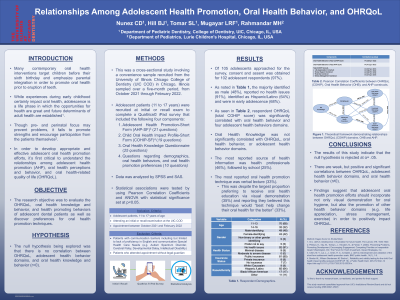
Methods: Adolescent patients (11 to 17 years) were recruited at their initial or recall exam. They completed a survey that included the 21-question Adolescent Health Promotion-Short Form (AHP-SF), the 19-question Child Oral Health Impact Profile-Short Form (COHIP-SF), and questions regarding oral health behaviors, knowledge, and promotion preferences. Statistical associations among constructs were tested by using Pearson correlation coefficients.
Results: 102 adolescents responded to the survey. The majority identified as male (48%), reported no health issues (91%), identified as Hispanic/Latino (64%) and were in early adolescence (68%). The most commonly reported source of health information was health professionals (46%). The most commonly reported oral health promotion technique was verbal lecture on hygiene and diet (33%). This is despite the largest proportion preferring to receive oral health education via visual demonstration (35%) and reporting they believed this technique would “best help change their oral health for the better” (33%). Adolescent OHRQoL (total COHIP score) was significantly associated with adolescent health behaviors of life appreciation (r=0.327, P=.001), social support (r=0.290, P=.004), exercise (r=0.251, P=.012), and stress management (r=0.210, P=.037).
Conclusions: Findings suggest that oral health promotion efforts should incorporate not only visual demonstration for oral hygiene, but also consider incorporating promotion of other health behavior domains (e.g. life appreciation, exercise, stress management) in an effort to positively impact OHRQoL.