
.png)
Patient Management

Adrienne M. Nguyen, DDS
Pediatric Dental Resident
Tufts University, Boston, MA
Tufts University, Boston, MA
Boston, Massachusetts, United States
Gerald Swee, BS, MS, DMD
Tufts University
Cheen Y. Loo, BDS, PhD, MPH, DMD
Professor, Chair and Program Director
Tufts University School of Dental Medicine
Boston, Massachusetts, United States
Matthew Finkelman, PhD
Tufts University School of Dental Medicine
Nikesha Walters, Bachelors Degree
Tufts University School of Dental Medicine
Cheen Y. Loo, BDS, PhD, MPH, DMD
Professor, Chair and Program Director
Tufts University School of Dental Medicine
Boston, Massachusetts, United States
Purpose:
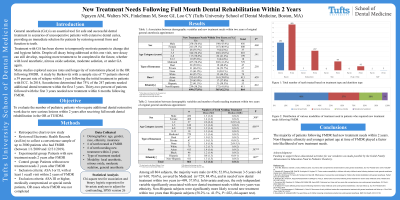
The aim of this study was to determine the percentage of patients needing treatment due to new carious lesions within 2 years of full mouth dental rehabilitation under general anesthesia.
Methods:
A 10-year retrospective chart review of electronic health records (axiUm) of cases of full mouth dental rehabilitation (FMDR) completed at Tufts University School of Dental Medicine from 1/1/2009 to 12/31/2019 was completed, ages 1-12. Information collected included type of treatment completed, how many teeth needed treatment, type of treatment modality, age at FMDR, gender, ethnicity, and insurance type. Associations were assessed using the chi-square test, with binary logistic regression and negative binomial regression also used to adjust for potential confounders.
Results:
Out of 1441 charts that were reviewed, 864 charts (one per subject) were included in the study. Of these subjects, 499 (58%) had new treatment needs within 2 years (95% CI: [55%, 61%]). Ethnicity was significantly associated with new treatment needs (P=.022). Age and ethnicity were significantly associated (P < .05) with new treatment needs when adjusting for the other independent variables, and significantly associated (P < .05) with the number of teeth needing treatment following FMDR. Patients aged 0-2 at time of FMDR needed on average 2 times more teeth treated compared to older patients.
Conclusion:
The majority of patients following FMDR will have new treatment needs within 2 years. Non-Hispanic ethnicity and younger patient age at time of FMDR may play a factor into likelihood of new treatment needs.