
.png)
Preventive

Reem Alajlan, B.D.S
Pediatric Dental Resident
Tufts University, Medford, MA
Tufts University
Boston, Massachusetts, United States
Gerald Swee, BS, MS, DMD
Tufts University
Sarah Pagni, BA, PHD, MPH
Tufts University
Abdullah Almulhim, BDS
Imam Abdulrahman Bin Faisal University
Cheen Y. Loo, BDS, PhD, MPH, DMD
Professor, Chair and Program Director
Tufts University School of Dental Medicine
Boston, Massachusetts, United States
Purpose: To assess parental acceptance of the utilization of Silver Diamine Fluoride (SDF) with Potassium Iodide (KI) compared to SDF without KI.
Methods: Parents of children aged 10 years and younger who received dental treatment at TUSDM Pediatric Dental Clinic were invited to participate in a Web-based questionnaire. The questionnaire was modified from a survey to investigate parents’ demographics, perceptions of photographs of SDF/KI and SDF without KI on their children’s anterior and posterior teeth, and acceptability of treatment in different behavior management scenarios.
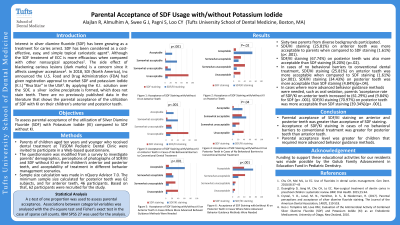
Results: Fifty-eight parents from diverse backgrounds participated. SDF/KI staining (70.69%) on anterior teeth was more acceptable to parents when compared to SDF staining (5.17 %) (p < .001). SDF/KI staining (86.21%) on posterior teeth was also more acceptable than SDF staining (33.33%) (p=.01). In cases of no behavioral barriers to conventional dental treatment, SDF/KI staining (67.25%) on anterior teeth was more acceptable when compared to SDF staining (6.89 %) (p < .001). SDF/KI staining (82.45 %) on posterior teeth was more acceptable than SDF staining (34.48%)(p=.01). In cases where more advanced behavior guidance methods were needed, such as oral sedation, parents ‘acceptance rate of SDF/KI on anterior teeth increased to 84.48% and 29.82% for SDF.
Conclusions: Parental acceptance of SDF/KI staining on anterior and posterior teeth was greater than acceptance of SDF staining. Acceptance of SDF/KI staining in cases of no behavioral barriers to conventional treatment was greater for posterior teeth than anterior teeth. Parental acceptance level was greater for children that required more advanced behavior guidance methods.