
.png)
Caries

Emily Nitta, DDS
Resident
Texas A & M University -—Baylor College of Dentistry, Dallas, TX
Texas A&M University- Baylor College of Dentistry, Dallas, TX
Dallas, Texas, United States
Nina Ray, DDS
Texas A&M College of Dentistry Pediatric Dentistry
Carolyn Kerins, DDS, PhD
Associate Professor and Graduate Program Director
Texas A & M University -—Baylor College of Dentistry, Dallas, TX
Dallas, Texas, United States
Carolyn Kerins, DDS, PhD
Associate Professor and Graduate Program Director
Texas A & M University -—Baylor College of Dentistry, Dallas, TX
Dallas, Texas, United States
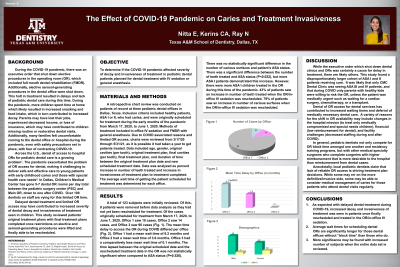
Purpose: To determine if the COVID-19 pandemic affected severity of decay and invasiveness of treatment in pediatric dental patients planned for dental treatment with IV sedation or general anesthesia.
Methods: A retrospective chart review was conducted on patients of record at three pediatric dental offices in Dallas, Texas. Inclusion criteria included patients originally scheduled for treatment from March 17, 2020 to June 1, 2020. Due to COVID associated reasons and limited operating room access, charts were reviewed from 3/17/20 through 5/31/21. Data included age, number of teeth with caries, original treatment plan, final caries, final treatment plan, and duration of time between the original treatment plan date and new scheduled treatment date. Data was analyzed as percent increase in number and increase in invasiveness of treatment plan to treatment completed. The average wait time of getting the patient scheduled for treatment was determined for each office.
Results: A total of 123 subjects were reviewed. The mean time delay to access the OR during COVID differed per office. The time lapsed between the original scheduled date and the rescheduled treatment date in the OR was not statistically significant when compared to ASA status (P=0.526). There was no statistically significant difference in the number of carious surfaces and patient’s ASA status. There was a significant difference between the number of teeth treated and ASA status (P <0.022), but more ASA I patients demonstrated this increase. However, there were more ASA I children treated in the OR during this time of the pandemic. 43% of patients saw an increase in number of teeth treated when treatment was rescheduled. 79% of patients saw an increase in number of carious surfaces when treatment was rescheduled.
Conclusions: As expected with delayed dental treatment during COVID-19, increased decay and invasiveness of treatment was seen in patients once finally rescheduled and treated in the OR/in-office IV sedation.
Average wait times for scheduling dental
ORs are significantly longer for those dental offices without block time than those who do.