
.png)
Patient Management

Thanh Nguyen, DMD
Dental Resident
NYU Langone- California
NYU Langone
San Diego, California, United States
Jacy Stauffer, DMD
NYU Langone - Califormia
San Diego, California, United States
Neves John, DDS
NYU Langone - California
Jacy Stauffer, DMD
NYU Langone - Califormia
San Diego, California, United States
Daniel J. Kane, DMD
Program Director
NYU Langone Health
Brooklyn, New York, United States
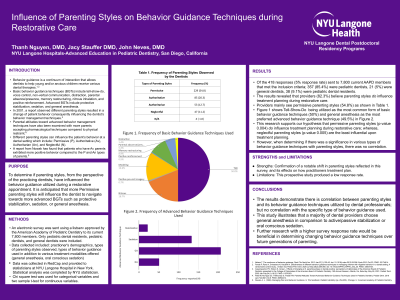
Purpose: The purpose of the study was to determine if different types of parenting styles perceived by the practicing dentists influence behavior guidance techniques utilized during restorative care.
Methods: All data was collected through an electronic survey using a listserv approved by the American Academy of Pediatric Dentistry (AAPD) to include current pediatric dental residents, pediatric dentists, and general dentists. The data collected consisted of the practitioner's demographics, type of parenting styles observed, and various treatment modalities offered.
Results: Of the 418 responses (5% response rate) sent to 7,800 current AAPD members that met the inclusion criteria; 357 (85.4%) were pediatric dentists, 21 (5%) were general dentists, and 38 (9.1%) were pediatric residents. The results revealed providers see mainly permissive parenting styles (54.8%) with Tell-Show-Do being utilized as the most common form of basic behavior guidance techniques (50%), and general anesthesia as the most preferred advanced behavior guidance technique (49.5%).
Conclusion: The results demonstrate there is no correlation between parenting styles and its behavior guidance techniques utilized by dental professionals. However, it illustrates that a majority of dental providers choose general anesthesia in comparison to active/passive stabilization or oral conscious sedation. Further research with a higher survey response rate would be beneficial in determining changing behavior guidance techniques over future generations of parenting.