
.png)
Caries


Isha Gandhi, DMD
Resident
NYU Lutheran Dental Medicine, Brooklyn, NY
Salisbury, Maryland, United States
Mariella De stefano, DDS
Site Associate Director
NYU Langone Dental Medicine - Maryland site
Princess Anne, Maryland, United States
Daniel J. Kane, DMD
Program Director
NYU Langone Health
Brooklyn, New York, United States
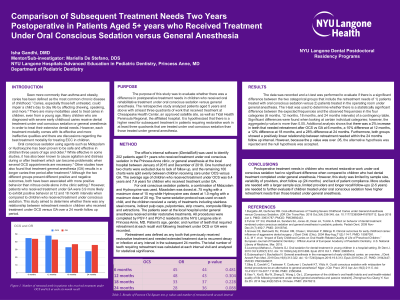
Objective: To determine if the treatment outcome for recurrent caries, defective restorations, and missing teeth in >=5 years old children is superior if treated in the operating room (OR) versus treated using oral conscious sedation (OCS).
Methods: A retrospective analysis was conducted using the electronic dental record (EDR) data of 5 years or older patients who received at least one comprehensive oral examination and caries treatment at Chesapeake Health Care Dental. Two hundred patients (100 patients in each group [OR vs. OCS]) dental history, prior dental treatments, medical history, allergies, and failed restoration information was obtained from EDR. Restoration failures at 6, 12, 18, and 24 months were determined. Statistical analysis with a 95% confidence interval was performed to determine whether treatments (restorations) performed in OR lasted longer than the restorations performed using OCS.
Results: The average age of our patient population was 6.4, with a majority of male patients. The average teeth that needed re-treatments at 6, 12, 18, and 24 months were 1, 2, 1, and 2, respectively, in the OR group. Similarly, in the OCS group, the average teeth that needed re-treatments at 6, 12, 18, and 24 months were 8, 8, 2, and 4. We rejected the null hypothesis as we found statistically significant difference (p < 0.05) in the OR group vs. OCS group.
Conclusion: Dental treatments provided under OR provided superior performance than OCS. Further studies are warned on a large dataset to confirm the findings.