
.png)
Caries

Jens K. Wilson, DMD
Pediatric Dental Resident
University of Nevada, Las Vegas, NV
University Las Vegas of Nevada
Las Vegas, Nevada, United States
Karl Kingsley, PhD, MPH
UNLV
Las Vegas, Nevada, United States
William Buhler, DDS
University of Nevada, Las Vegas, NV
Las Vegas, Nevada, United States
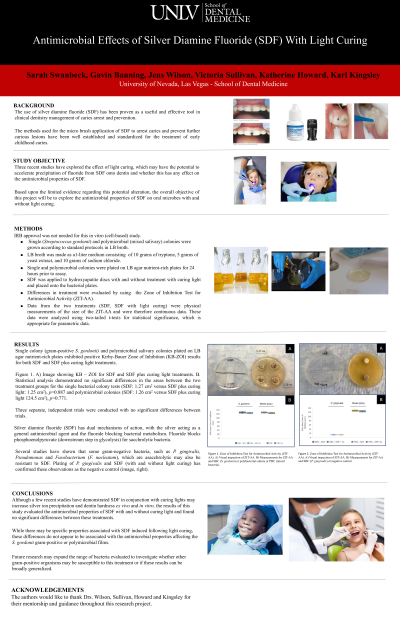
Purpose: The purpose of this research is to explore the antimicrobial properties of SDF on oral microbes with and without light curing.
Methods: Single (Streptococcus gordonii) and polymicrobial (mixed salivary) colonies will be grown according to standard protocols in LB broth and plated on LB agar nutrient-rich plates for 24 hours prior to assay. SDF will be applied to hydroxyapatite discs with and without treatment with curing light and placed onto the bacterial plates. Differences in treatment will be evaluated by using the Zone of Inhibition Test for Antimicrobial Activity (ZIT-AA).
Results: Analysis of these data revealed no significant differences in the areas between the two treatment groups (SDF: 1.27 cm2 versus SDF plus curing light: 1.25 cm2), P=0.887 in both the single and polymicrobial colony experiments. Additional tests to evaluate duration of curing light application are on-going.
Conclusions: Although recent studies have demonstrated SDF in conjunction with curing lights may increase silver ion precipitation and dentin hardness ex vivo and in vitro, the results of this study evaluated the antimicrobial properties of SDF with and without curing light and found no significant differences between these treatments. Although there may be specific properties associated with SDF following light curing, these differences do not appear to be associated with the antimicrobial properties affecting gram-positive or polymicrobial films.