
.png)
Preventive


Rebecca AW Maginot, DDS, MS
Pediatric Dental Resident
UNLV
UNLV
Las Vegas, Nevada, United States
Karl Kingsley, PhD, MPH
UNLV
Las Vegas, Nevada, United States
William Buhler, DDS
University of Nevada, Las Vegas, NV
Las Vegas, Nevada, United States
Changing perspectives of pediatric HPV vaccination among dental students and residents
Background
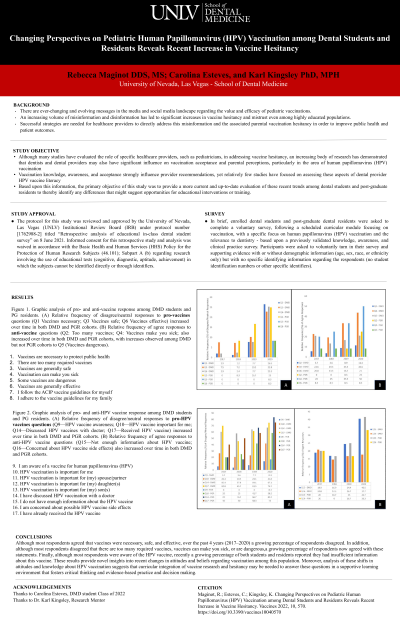
There are ever-changing and evolving messages in the media and social media landscape regarding the value and efficacy of pediatric vaccinations [1]. Communication between healthcare providers and patients is becoming increasingly more important and also more controversial [2]. Although some studies have focused on educational interventions to improve HPV vaccination rates [3], few studies have focused on evaluation of HPV vaccination knowledge, awareness and acceptance among dental students and post-graduate residents to determine which (if any) educational interventions are needed [4].
Although some additional efforts have been made to evaluate HPV and HPV vaccine-specific literacy and the opportunities to provide educational interventions or initiatives, it is clear that attitudes and awareness are changing – particularly among new trained healthcare professionals and those in-training [5,6]. Although one study from this institution was successful in evaluating dental student and dental resident awareness, knowledge and acceptance of HPV vaccination – these data were collected several years ago while attitudes and behaviors have been shifting [4]. Based upon the changing nature of these attitudes a more current, up-to-date evaluate of this information should be undertaken to assess the current situation among current residents and current dental students and whether any differences between these two populations may reveal opportunities for educational interventions or training.
Research question To evaluate the awareness, knowledge and attitudes towards HPV vaccination among current dental students and current residents at UNLV-SDM. Differences between these two group will be evaluated to determine if any training or educational opportunities exist. Null hypothesis: There will be no difference between dental student and dental resident awareness, knowledge and acceptance of HPV vaccination. Alternative hypothesis: There will be differences between dental student and dental resident awareness, knowledge and acceptance of HPV vaccination. Methods Institutional Review Board (IRB) approval will be sought to assess dental student and dental resident awareness, knowledge and acceptance of HPV vaccination. Dr. Kingsley teaches Microbiology and Immunology to all the current dental students and dental residents and regularly conducts these surveys for educational purposes. A former resident analyzed previously collected HPV vaccination surveys – while this study will evaluate these surveys from current students and residents. Although the data will need to be blinded to prevent the release of personal identifying information (such as name), an analysis of demographic information, such as age, race/ethnicity and program (DMD or residency) will be available. The survey instrument has been previously validated and contains n=18 questions. Eight questions involve general vaccine awareness, knowledge and acceptance. Ten questions involve HPV vaccines awareness, knowledge and acceptance. Statistical analysis Demographic data regarding the survey respondents will be categorical (non-parametric data), such as Sex (Male or Female) and Race/Ethnicity (Minority or non-Minority). This type of data is usually presented as descriptive statistics, such as percentages of total responses. Because not all students and residents were required to participate the percentages of respondents can be compared with the overall student and resident demographics. Because the data are categorical (non-parametric), the most likely form of statistical analysis will be Chi square – which is appropriate to analyze this type of data. Analysis of the survey responses themselves will be more complex than simply reporting percentages. Because these responses will involve measurable data on a scale (1 – 5; strongly agree to strongly agree) these will be parametric data. The most appropriate way to analyze this type of data (parametric) will be using t-tests. Measuring differences between responses to individual questions sorted by Sex or Race can be accomplished using t-tests.