
.png)
Sedation
AAPD Member Sedation Practices by Geographical Region, Walters K, Curtis S (Hennepin County Medical Center, Minneapolis, MN)

Kimberly Walters, DMD
Pediatric Dentistry Resident
Hennepin County Medical Center
Hennepin County Medical Center
Bloomington, Minnesota, United States
Sarah Curtis, DMD
Pediatric Dental Resident
Hennepin County Medical Center
Hennepin County Medical Center
Minneapolis, Minnesota, United States
John Conry, BDS
Casual Faculty
Hennepin County Medical Center
Minneapolis, Minnesota, United States
Elisabeth Fulling, DDS
Pediatric Dentistry Faculty
Hennepin Healthcare
Minneapolis, Minnesota, United States
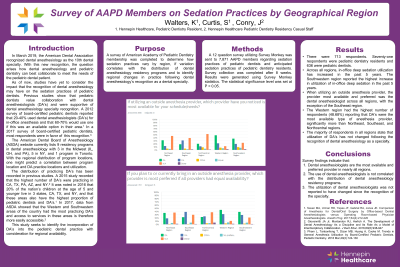
Purpose: A survey of American Academy of Pediatric Dentistry membership was completed to determine how sedation practices vary by region, if variation correlates with the distribution of dental anesthesiology residency programs and to identify regional changes in practice following dental anesthesiology’s recognition as a dental specialty.
Methods: A 12 question survey was sent to 7,871 AAPD members regarding sedation practices of pediatric dentists and anticipated sedation practices of pediatric dentistry residents.
Results: There were 713 respondents. Seventy-one respondents were pediatric dentistry residents and 636 were pediatric dentists. Across all regions, in-office deep sedation utilization has increased in the past 5 years. The Southwestern region reported the highest increase in utilization of in-office deep sedation in the past 5 years. When utilizing an outside anesthesia provider, the provider most available and preferred was the dental anesthesiologist across all regions, with the exception of the Southeast region. The Western region had the highest number of respondents (48.68%) reporting that dental anesthesiologists were the most available type of anesthesia provider, significantly more than the Northeast, Southeast, and Northcentral regions. The majority of respondents in all regions state that utilization of dental anesthesiologists has not changed following the recognition of dental anesthesiology as a specialty.
Conclusions: Survey findings indicate that use of dental anesthesiologists is not correlated with the distribution of dental anesthesiology residency programs and that utilization of dental anesthesiologists has not changed since the recognition of this specialty. However, dental anesthesiologists are the most available and preferred provider in nearly all regions.