
.png)
Preventive


Chantai N. Harris, DDS
PGY-2 Pediatric Dental
New York University, New York, NY
New York, New York, United States
Jillian Kaye, RDN, RDN
New York University College of Dentistry
Elizabeth Best, MPH
Grants and Research Administrator
New York University
New York, New York, United States
Lauren Feldman, DMD
Postdoctoral Program Director
New York University
New York, New York, United States
Lauren Feldman, DMD
Postdoctoral Program Director
New York University
New York, New York, United States
Purpose: Dietary counseling is a well accepted tool for caries prevention. This study evaluates first and second year pediatric dental residents’ self-reported knowledge in diet and nutrition counseling and their comfort level and willingness to administer counseling in the pediatric dental clinical setting.
Methods: A Qualtrics survey was sent to 886 postgraduate pediatric dental residents attending accredited training programs with full membership as “resident” status with the AAPD. The survey consisted of 30 questions pertaining to pre-residency knowledge of nutrition and diet counseling, experience during residency, current use of dietary counseling, and perceived barriers to dietary counseling in the dental setting.
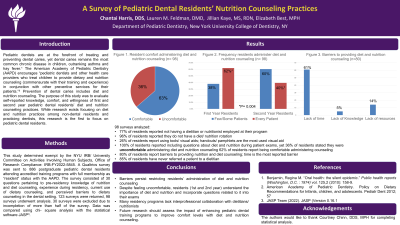
Results: 98 surveys were analyzed. 77% of residents reported not having a dietitian or nutritionist employed at their program. 96% of residents reported they do not have a diet/ nutrition rotation. 26% of residents report using tools/ visual aids; handouts/ pamphlets are the most used visual aid.100% of residents reported including questions about diet and nutrition during patient exams, yet 36% of residents stated they were uncomfortable administering diet and nutrition counseling 62% of residents report being comfortable administering counseling.80% of residents report barriers to providing nutrition and diet counseling; time is the most reported barrier.85% of residents have never referred a patient to a dietitian.
Conclusions: Future research should assess the impact of enhancing pediatric dental training programs to improve comfort levels with diet and nutrition counseling.Barriers persist restricting residents’ administration of diet and nutrition counseling.