
.png)
Patient Management

Scott Allen, DDS
Pediatric Dental Resident
NYU Lutheran Dental Medicine, Brooklyn, NY
NYU Langone Advanced Education in Pediatric Dentistry, Tucson, AZ
Sahuarita, Arizona, United States
Amanda Pinder, DDS
Program Director
NYU-Langone Hospital
Tucson, Arizona, United States
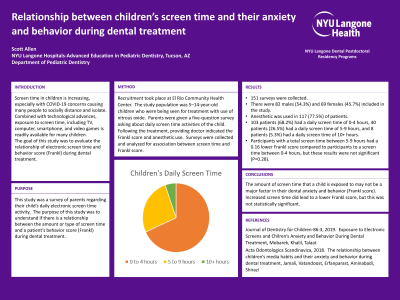
Purpose: This study will be a survey of parents regarding their child’s daily electronic screen time activity. The purpose of this study is to understand if there is a relationship between the amount or type of screen time and a patient’s behavior score (Frankl) during dental treatment.
Methods: Recruitment took place at El Rio Community Health Center. The study population was 5–14-year-old children who were being seen for treatment with use of nitrous oxide. Parents were given a five-question survey asking about daily screen time activities of the child. Following the treatment, providing doctor indicated the Frankl score and anesthetic use. Surveys were collected and analyzed for association between screen time and Frankl score.
Results: 151 surveys were collected. There were 82 males (54.3%) and 69 females (45.7%) included in the study. Anesthetic was used in 117 (77.5%) of patients. 103 patients (68.2%) had a daily screen time of 0-4 hours, 40 patients (26.5%) had a daily screen time of 5-9 hours, and 8 patients (5.3%) had a daily screen time of 10+ hours. Participants with a total screen time between 5-9 hours had a 0.16 lower Frankl score compared to participants to a screen time between 0-4 hours, but these results were not significant (P=0.28).
Conclusions: The amount of screen time that a child is exposed to may not be a major factor in their dental anxiety and behavior (Frankl score). Increased screen time did lead to a lower Frankl score, but this was not statistically significant.