
.png)
Caries

Anjalee N. Shah, DMD
Pediatric Dental Resident
The University of Toledo Medical Center, Toledo, OH
University of Toledo Medical Center
Toledo, Ohio, United States
Michael P. Nedley, DDS
Assistant Professor
University of Toledo
Toledo, Ohio, United States
Michael P. Nedley, DDS
Assistant Professor
University of Toledo
Toledo, Ohio, United States
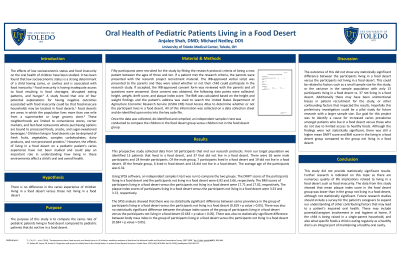
Purpose: The objective of this study is to compare the caries rate of pediatric patients living in food deserts compared to pediatric patients that do not live in a food desert.
Methods: Demographic and clinical information was collected including patient height, weight, BMI, plaque index score, dmft/DMFT scores, and zip code on a total of 50 patients between the ages of 3-10. A t-test was conducted to compare the children in the food desert group versus children not living in the food desert group.
Results: Based on my current findings, 26% of the study population live in a food desert. There is no suspected statistically significant difference in dmft/DMFT scores, plaque index scores, or BMI between the children living in a food desert versus children not living in a food desert.
Conclusions: From an oral health perspective, living in a food desert does not negatively impact a child’s oral health.