
.png)
Syndromes/Craniofacial Anomalies

.jpg "Alexandra R. Kolar, DDS photo")
Alexandra R. Kolar, DDS
Resident
Indiana University School of Dentistry, Indianapolis, IN - Riley Hospital for Children
Indiana University School of Dentistry
Indianapolis, Indiana, United States

James E. Jones, DMD, PhD, EdD, MSD, MA
Faculty
Indiana University School of Dentistry, Indianapolis, Indiana - Riley Hospital for Children
Indianapolis, Indiana, United States
LaQuia A. Vinson, DDS, MPH
Pediatric Dentistry Residency Program Director
Indiana University School of Dentistry
Indianapolis, Indiana, United States
Kolar, AK, Jones, JE, Vinson, LA. Bilateral Supernumerary Maxillary Primary and Permanent Canines in Williams Syndrome (Indiana University Riley Hospital for Children, Indianapolis, IN)
Introduction: Williams Syndrome (WS) is a rare genetic condition resulting from a microdeletion on chromosome 7q11-23. Patients with WS often present with at least one dental developmental abnormality including diastemas, hypoplasia, and hypodontia. Castro, et al., who evaluated oral characteristics in 52 subjects with WS, reported that 50.9% were found to have some form of hypodontia. Axelsson, et al., evaluated 41 individuals with WS and reported that 40.5% experienced agenesis of at least one permanent tooth, while 11.9% experienced agenesis of 6 or more permanent teeth. Due to these findings, it is crucial that patients with Williams Syndrome receive early diagnosis of missing teeth for treatment planning purposes.
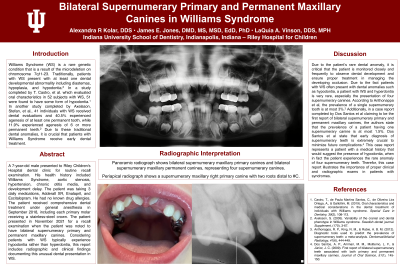
Case Abstract: A 7-year-old male presented to Riley Children’s Hospital dental clinic for routine recall examination. His health history included Williams Syndrome, aortic stenosis, hypertension, chronic otitis media, and development delay. The patient was taking 3 daily medications, Adderall XR, Enalapril, and Escitalopram. He had no known drug allergies. The patient received comprehensive dental treatment under general anesthesia in September 2018, including each primary molar receiving a stainless steel crown. The patient presented in November 2021 for a recall examination when the patient was noted to have bilateral supernumerary primary and permanent maxillary canines. Considering patients with WS typically experience hypodontia rather than hyperdontia, this report includes radiographic and clinical findings documenting this unusual dental presentation in WS.