
.png)
Syndromes/Craniofacial Anomalies
Zimmermann-Laband Syndrome in a Pediatric Patient


John Schlotz, DDS
Pediatric Dentistry Resident Year 1
Indiana University School of Dentistry
Indiana University School of Dentistry
Indianapolis, Indiana, United States

Juan F. Yepes, DDS, MD, MPH, MS, DrPH, FDS, RCDS(Ed)
Professor in the Department of Pediatric Dentistry
Indiana University School of Dentistry
Indiana University -Riley Children Hospital-
Indianapolis, Indiana, United States
Juan F. Yepes, DDS, MD, MPH, MS, DrPH, FDS, RCDS(Ed)
Professor in the Department of Pediatric Dentistry
Indiana University School of Dentistry
Indiana University -Riley Children Hospital-
Indianapolis, Indiana, United States
LaQuia A. Vinson, DDS, MPH
Pediatric Dentistry Residency Program Director
Indiana University School of Dentistry
Indianapolis, Indiana, United States
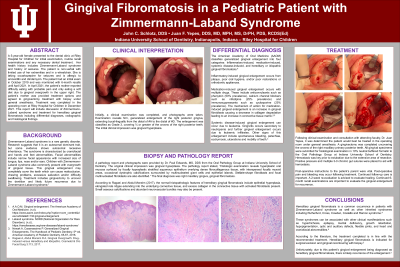
Introduction: Zimmermann-Laband Syndrome is a rare genetic disorder. Research suggests that it is an autosomal dominant trait but some evidence shows autosomal recessive inheritance. The syndrome is characterized by craniofacial and hands and feet abnormalities. Facial abnormalities include narrow facial appearance with increases size of tongue, lips, nose, and/or ears. Children with Zimmermann-Laband Syndrome also commonly present with overgrowth of gingival tissue. This gingival hyperplasia may completely cover the teeth. This can cause malocclusion, chewing problems, excessive salivation, and/or difficulty swallowing. Treatment includes gingivectomy to uncover dentition with a likely future recurrence due to Zimmermann-Laband Syndrome.