
.png)
Patient Management

Aderonke Ogunbameru, DDS
pediatric dental resident
Howard University, Washington, D.C.
Howard University
NW, District of Columbia, United States
Shohreh Sharif, DDS
Associate Professor
Howard University College of Dentistry
NW, District of Columbia, United States
Shohreh Sharif, DDS
Associate Professor
Howard University College of Dentistry
NW, District of Columbia, United States
LaToya Barham, DDS, FAAPD
Chair and Program Director
Howard University College of Dentistry
NW, District of Columbia, United States
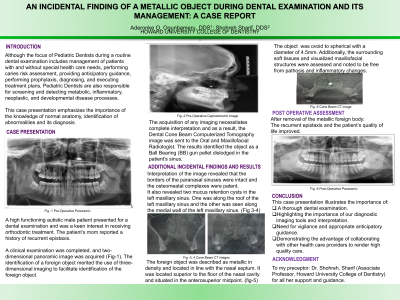
Purpose: Although the focus of pediatric dentists during a routine dental examination includes management of patients with and without special health care needs, performing caries risk assessment, providing anticipatory guidance, performing prophylaxis, diagnosing, and executing treatment plans, they are also responsible for screening and detecting metabolic, inflammatory, neoplastic, and developmental disease processes. This case presentation emphasizes the importance of the knowledge of normal anatomy, identification of abnormalities and its diagnosis.
Methods: A high functioning autistic male patient presented for a dental examination with a keen interest in receiving orthodontic treatment. The patient’s mom reported a history of recurrent epistaxis. A clinical examination was completed, and a panoramic image was acquired. The identification of a foreign object merited the use of three-dimensional imaging to facilitate identification of the foreign object.
Results: The acquisition of any imaging necessitates complete interpretation and as a result, the Cone Beam Computerized Tomography image was sent to the Oral and Maxillofacial Radiologist. The results identified the object as a Ball Bearing (BB) gun pellet dislodged in the patient’s ethmoid sinus.
Conclusion: Once diagnosed, patient had the foreign body removed by the ENT specialist under general anesthesia. Its removal resolved the occasional reports of epistaxis thereby improving quality of life. This case presentation illustrates the importance of a thorough dental examination, careful interpretation of all images acquired while highlighting the importance of our diagnostic image tools and demonstrates the advantage of collaborating with other health care professionals to render high quality care for our patients.