
.png)
Orthodontics


Paloma R. Nguyen, DMD
Pediatric Dental Resident PGY-2
University of Texas — Houston, Houston, TX
University of Texas — Houston, Houston, TX
Houston, Texas, United States
Elsa Echeverri, DDS
University of Texas Health Science Center at Houston School of Dentistry
Houston, Texas, United States

Brett T. Chiquet, DDS, PhD
Associate Professor Non-Tenure Clinical
University of Texas Health Science Center at Houston School of Dentistry
University of Texas School of Dentistry
Houston, Texas, United States
Introduction: Anterior cross-bites are the result of an abnormal labio-lingual relationship between maxillary and mandibular anterior incisors. Anterior cross-bites generally present in the mixed dentition and are identified clinically by the presence of a negative overjet while the patient is in centric occlusion. The etiology of anterior cross-bites can be dental or skeletal in origin, or a combination of both. Treatment is indicated for anterior cross-bites as soon as a diagnosis is made. The sequalae of untreated anterior cross-bites include attrition, damage to the periodontium, tooth mobility, restricted skeletal growth, TMJ dysfunction and loss of esthetics.
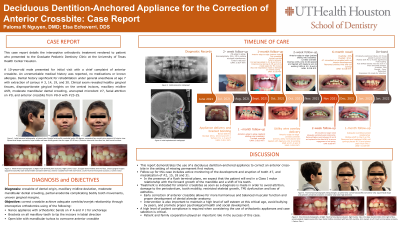
Case Report: This case report details the interceptive orthodontic treatment rendered to a 10-year-old male who presented to the Graduate Pediatric Dentistry Clinic at the University of Texas Health Center Houston with a chief complaint of an anterior cross-bite and low self-esteem due to judgement from peers. The patient’s medical history was unremarkable, no medications or known allergies were reported. Dental history, according to mother, was significant for rehabilitation under general anesthesia at age 7 when #3, 14, 19 and 30 were extracted due to caries involvement. Clinical exam revealed a microdont #7, anterior cross-bite from #8-9 with #23-25, facial attrition on #9, disproportionate gingival heights on the central incisors, and a maxillary midline shift. This report demonstrates the use of a deciduous dentition-anchored appliance to correct an anterior cross-bite in the setting of missing first permanent molars.