
.png)
Caries


Kelley Fischer, DDS
Resident
University of Florida —Gainesville and Naples, Naples, FL
University of Florida
Naples, Florida, United States
Lauren Governale, DMD
Clinical Program Director
University of Florida - Naples
Naples, Florida, United States
Maria Davila Gonzalez, DDS, MPH, DrPH
University of Florida
Susan Gorman, RDH, M Ed.
University of Florida
Abimbola O. Adewumi, DDS
Program Director
Florida
Gainesville, Florida, United States
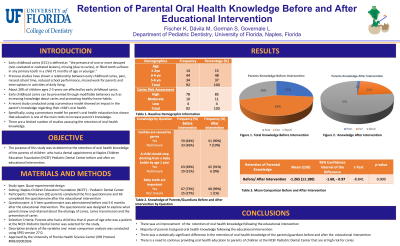
Purpose: The purpose of this research was to determine the retention of parental oral health knowledge before and after an educational intervention.
Methods: A quasi-experimental design study involving a 5-item questionnaire was applied before an educational intervention and 3 to 6 months after the educational intervention, at the NCEF-Pediatric Dental Center. Ninety-two (92) parents completed the first questionnaire, and 68 (73%) of them were able to complete the 3 to 6 months’ follow-up after the educational intervention. The questionnaire was designed to explore what parents who visit the NCEF Pediatric Dental Center know about caries etiology, transmission, and prevention. Parents who had a child less than 6 years of age that was a patient at the NCEF Pediatric Dental Center qualified for this study.
Results: The majority of the parents (47.8%) had a child between 3-4 years of age (3.98±1.24). Seventy-eight (84%) children had a high caries risk assessment. Twenty (29.4%) of the parents had “good” knowledge prior to the intervention. Following the educational intervention 76.5% of parents had “good” oral health knowledge. When comparing the before and after interventions means a statistical significance difference (P=.001) was observed.
Conclusion: The results showed that there was an improvement in retained oral health knowledge following the educational intervention. Majority of parents demonstrated good oral health knowledge following the educational intervention. There is a need of continuing oral health education to the parents of those high risk children.