
.png)
Preventive
Comparing Shoe Lace Tying With Effective Tooth Brushing (Plaque Score)

Srivarsha (Varsha) Ponna, DDS
Pediatric Dental Resident
St. Barnabas Hospital
New York, New York, United States
Paul Chu, DDS
Program Director
St. Barnabas Hospital
Bronx, New York, United States
Angie Papandrikos, DMD
Attending, Research Mentor
St. Barnabas Hospital
Bronx, New York, United States
Angie Papandrikos, DMD
Attending, Research Mentor
St. Barnabas Hospital
Bronx, New York, United States
Paul Chu, DDS
Program Director
St. Barnabas Hospital
Bronx, New York, United States
Evaluating the ability to tie shoelaces with tooth brushing - S Ponna DDS, A Papandrikos DDS, P Chu DDS, R Tannen DDS, C Lane DDS, D Rosenberg DDS
(St. Barnabas Hospital/SBH Health Systems, Bronx, NY)
Introduction: One of the goals of pediatric dentistry is to educate parents and patients about the importance of effective tooth brushing, However, parents often state that their children brush their teeth independently. In fact, many parents stop brushing their children’s teeth for them long before 10 years of age. Contrastingly, current literature shows that children below 10 years of age have difficulty applying brushing movements due to poor manual dexterity and limited fine and gross motor skills (Deinzer R, 2019).
Purpose:
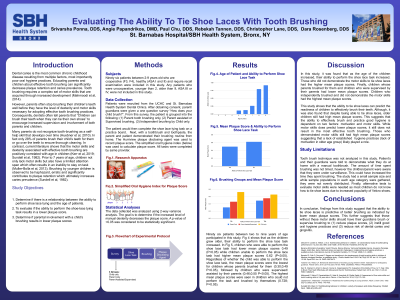
(1) Determine if there is a relationship between the ability to perform shoe lace tying and the age of patients.
(2) To evaluate if the ability to perform the shoe-lace tying task results in a lower plaque score.
(3) Determine if parental involvement with a child’s brushing results in lower plaque scores
Methods: In 96 recall visits, a child’s motor skills was assessed through a survey and a shoe lace tying task, followed by a demonstration of their regular tooth brushing routine. The Hurriview plaque disclosing agent was used to obtain the plaque score.
Results: As the children grew older, their ability to perform the shoe lace task increased. Children who were able to perform the shoe lace task had lower mean plaque scores 0.49 (P <0.05) while children unable to perform the shoe lace task had higher mean plaque scores 0.62 (P <0.05). The mean plaque scores were the lowest for children whose parents brushed for them (0.30;0.49 P<0.05), followed by children who were supervised/ assisted by their parents (0.46;0.55 P<0.05). The highest mean plaque scores were seen in children who could not perform the task and brushed by themselves.
Conclusions: This findings suggest that the ability to tie shoe laces is predictive of better brushing as indicated by lower mean plaque scores. The data further suggests that those without the motor skills to tie shoe laces should have their guardians brush or supervise brushing to (1) reduce plaque scores, (2) instill good oral hygiene practices and (3) reduce risk of dental caries and gingivitis.