
.png)
Preventive

Jon C. Federspiel, DDS
Pediatric Dentistry Resident
University of Texas —San Antonio, TX
University of Texas - San Antonio, TX
San Antonio, Texas, United States
Hohyun R. Ryou, DDS
University of Texas - San Antonio
Cristina Leon-Pineda, DDS, MPH, MSDS
University of Colorado - Children's Hospital

Kevin J. Donly, DDS, MS
Professor and Chair
University of Texas - San Antonio
San Antonio, Texas, United States
Kevin J. Donly, DDS, MS
Professor and Chair
University of Texas - San Antonio
San Antonio, Texas, United States
Maria Jose Cervantes Mendez, DDS, MS
Program Director
University of Texas Health San Antonio
San Antonio, Texas, United States
Evaluating the Staining Effects of Chlorhexidine Gluconate Mouth Rinse on Demineralized Enamel.
Federspiel JC, Ryou HR, Donly KJ, Leon-pineda CM (University of Texas Health Science Center of San Antonio, Department of Pediatric Dentistry, San Antonio, TX)
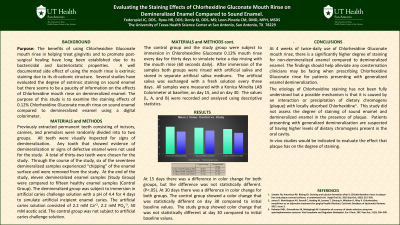
Purpose: The benefits of using Chlorhexidine Gluconate mouth rinse in helping treat gingivitis and to promote post-surgical healing have long been established due to its bactericidal and bacteriostatic properties. An unfortunate side effect however of using the mouth rinse is extrinsic staining due to its di-cationic structure. Several studies have evaluated the degree of extrinsic staining on sound enamel but there seems to be a paucity of information on the effects of Chlorhexidine mouth rinse on demineralized enamel. The purpose of this study was to examine the staining effects of 0.12% Chlorhexidine Gluconate mouth rinse on sound enamel compared to demineralized enamel using a digital colorimeter.
Methods: Twenty-six previously extracted permanent teeth consisting of incisors, canines, and premolars were randomly divided into to two groups. Group 1, the controlled group, consisted of sound enamel samples while Group 2, the demineralized group, was subject to immersion of artificial caries challenge solution (pH 4.4) for 4 Days to simulate artificial incipient enamel caries samples. Both groups were kept in an artificial saliva medium during the study. Groups 1 and Groups 2 were subject to twice-daily Chlorhexidine Gluconate immersion for 30 seconds each time to simulate rinsing for 30 days. Color values were recorded at baseline, 2 weeks, and 4 weeks for the two groups.
Results: At week 2, even though there was a difference in color change for both groups, there was not a statistically significant difference between the two groups (P < .05). The major differences in color changes were found at week 4 when the L value (lightness) was significantly higher for the control group compared to group 2 (P=.006).
Conclusions: At 4 weeks of twice-daily use of Chlorhexidine Gluconate mouth rinse, there is a significantly higher degree of staining for demineralized enamel compared to sound enamel. These findings should be taken into consideration when prescribing Chlorhexidine Gluconate 0.12% for periods greater than 2 weeks in patients presenting with clinically detectable demineralized enamel surfaces.