
.png)
Patient Management


Hannah Loseke, DDS
Pediatric Dental Resident
Cincinnati Children’s Medical Center Hospital, Cincinnati, OH
Cincinnati Children's Hospital Medical Center
Newport, Kentucky, United States

Jennifer L. Cully, DMD, MEd
Associate Professor
Cincinnati Children's Hospital Medical Center
Cincinnati Children's Hospital Medical Center
Cincinnati, Ohio, United States
Giulia Castrigano, DDS, MS
Cincinnati Children’s Medical Center Hospital, Cincinnati, OH
Colleen Mangeot, MS, PStat
Cincinnati Children’s Medical Center Hospital, Cincinnati, OH
Elizabeth Gosnell, DMD, MS
Cincinnati Children’s Medical Center Hospital, Cincinnati, OH
Cincinnati, Ohio, United States
Elizabeth Gosnell, DMD, MS
Cincinnati Children’s Medical Center Hospital, Cincinnati, OH
Cincinnati, Ohio, United States

Annmarie Matusak, DDS, DDS
Program Director
Cincinnati Childrens Hospital Medical Center (Cincinnati, OH)
Cincinnati Children's Hospital Medical Center
Cincinnati, Ohio, United States
Purpose: To evaluate AAT utilization in pediatric dental practices and residency programs in the US and Canada.
Methods: Two unique electronic surveys were sent to pediatric dentists (PD) and pediatric dental residency program directors (RD) to ask about familiarity, use, and education on AAT. Descriptive statistics of counts and percent were calculated. Fisher’s exact test was used to examine differences between pediatric dentists and residency programs with alpha=0.05 for the significance level.
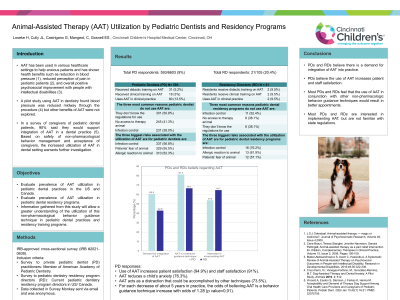
Results: Five hundred ninety-three (9%) of PDs and 21 (20.4%) of RDs responded. Most PDs (60.5%) believed there is a demand for integration of AAT in comparison to RDs (42.9%), although not significantly different (P=.12). PDs (81.3%) and RDs (66.7%) believed AAT is a behavior guidance technique (P=.15). PDs believed use of AAT increases patient satisfaction (94.9%) and staff satisfaction (91%, 71/80). While PDs believed AAT reduces a child’s anxiety (76.3%), they also believe AAT acts as a distraction that could be accomplished by other techniques (73.5%). Top 3 reasons AAT is not currently used by RDs and PDs include no access to therapy animal, unknown regulations, and infection control. Most RDs (64.7%) are interested in incorporating AAT into curriculum and most PDs are interested in learning how to implement AAT use into practice (53.9%).
Conclusions: PDs and RDs believe there is a demand for integration of AAT into practice and believe the use of AAT increases patient and staff satisfaction. Most PDs and RDs are interested in implementing AAT but are not familiar with state regulations.