
.png)
Caries


Stephanie Bollow, DMD
Resident
University of Illinois Chicago, Chicago IL
University of Illinois Chicago, Chicago IL
Downers Grove, Illinois, United States
Leda Mugayar, DDS, MS
Associate Professor
University of Illinois at Chicago, Chicago IL
Chicago, Illinois, United States
Scott Tomar, DMD, DrPH
University of Illinois at Chicago, Chicago, IL
Sheela Raja, PhD
University of Illinois at Chicago
Leda Mugayar, DDS, MS
Associate Professor
University of Illinois at Chicago, Chicago IL
Chicago, Illinois, United States
.jpg "David M. Avenetti, DDS, MSD, MPH photo")
David M. Avenetti, DDS, MSD, MPH
Associate Professor & Residency Program Director
University of Illinois Chicago, College of Dentistry
University of Illinois Chicago, Dept. of Pediatric Dentistry
Chicago, Illinois, United States
The Effects of Secondhand Smoke Exposure on Early Childhood Caries, Bollow SE, Mugayar L, Tomar SL, Raja S (University of Illinois Chicago College of Dentistry, Chicago, IL)
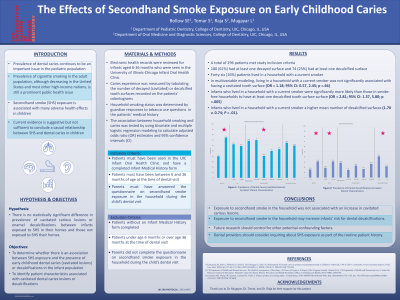
Purpose: to determine the association between exposure to secondhand smoke and dental caries in an infant population.
Methods: Electronic health records were reviewed for infants aged 6-36 months who were seen in a university-based post-graduate Infant Oral Health Clinic. Caries experience was measured by tabulating the number of decayed (cavitated) or decalcified tooth surfaces recorded on the patients’ odontograms. Household smoking status was determined by guardian responses to tobacco use questions in the patients’ medical history. The association between household smoking and caries was tested by using stratified bivariate analysis to calculate age-adjusted odds ratio (OR) estimates and 95% confidence intervals (CI).
Results: A total of 296 patients met study inclusion criteria (mean age=1.56 years, SD=0.57). Of those, 180 (61%) had at least one decayed surface and 74 (25%) had at least one decalcified surface. Forty-six (16%) patients lived in a household with a current smoker. Living in a household with a current smoker was not significantly associated with having a decayed tooth surface (OR 1.25; 95% CI: 0.65, 2.43; P=.501); however, infants who lived in a household with a current smoker were significantly more likely than those in smoke-free households to have at least one decalcified tooth surface (OR 2.50; 95% CI: 1.29, 4.86; P=.006) and had a higher mean number of decalcified surfaces (1.70 v. 0.74; P=.01).
Conclusion: Exposure to secondhand smoke in the household may increase infants’ risk for dental decalcifications. Future research should control for other potential confounding factors.