
.png)
Sedation


Tommy C. Burke, DDS
Pediatric Dentist
Beech Lake Pediatric Dentistry, Lexington, TN
Lexington, Tennessee, United States
Tommy C. Burke, DDS
Pediatric Dentist
Beech Lake Pediatric Dentistry, Lexington, TN
Lexington, Tennessee, United States
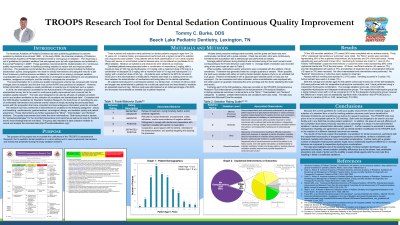
Purpose: The purpose was to evaluate the Tracking and Reporting of Procedural Sedation (TROOPS) Research Tool for use in in-office, pediatric oral conscious sedations.
Methods: Three hundred oral sedations were performed on dental patients ranging in ages from 2 to 12 years old. The TROOPS Research tool/form was used to record data regarding “unplanned interventions or outcomes” from each sedation.
Results: Of the 300 recorded sedations, 271 cases (90%) were completed with no adverse events. Twenty-nine (10%) “unplanned interventions or outcomes” were noted. Six “Minor” events were recorded, representing 20% of the unplanned interventions and outcomes and 2% of the total cases. Airway repositioning was performed 5 times (2%). Suctioning for emesis was noted in 1 case (0.3%). Twenty “Intermediate” unplanned interventions or outcomes were noted representing 69% of the unplanned events and 7% of the total cases. Of these, insufficient sedation (20 cases or 7%), provider dissatisfaction (20 cases or 7%), and abortion of treatment due to uncooperative behavior (10 cases or 3%) were recorded. No other intermediate level interventions were performed. No “Sentinel” interventions or outcomes were needed or observed.
Nausea without vomiting was reported in 2 (1%) cases. Vomiting occurred in 3 cases (1%). Active restraint was used in 4 cases (1%).
Conclusions: ”Continuous quality improvement” protocols are recommended for tracking sedation outcomes. This TROOPS tool meets or exceeds the recommended guidelines, and the data from this study supports the hypothesis that oral conscious sedation can be used safely in dental patients when established guidelines are followed.