
.png)
Preventive

Anna Lam, DMD
PGY-2
NYU Lutheran Dental Medicine, Brooklyn, NY
Worcester, Massachusetts, United States
Amir Yavari, DDS
Associate Director
NYU Langone
Providence, Rhode Island, United States
Daniel J. Kane, DMD
Program Director
NYU Langone Health
Brooklyn, New York, United States
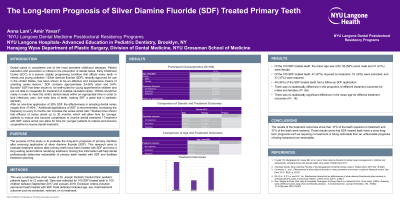
Purpose: The purpose of this study is to evaluate the long-term prognosis of primary dentition after receiving application of silver diamine fluoride (SDF). This research aims to evaluate treatment options after primary teeth have been treated with SDF and have a long waiting period before rendering treatment. Having this information will help dental professionals determine restorability of primary teeth treated with SDF and facilitate treatment planning.
Methods: This was a retrospective chart review of St. Joseph Pediatric Dental Clinic pediatric patients ages 0 and 12 years old. Data was collected for 100 SDF treated teeth in 100 children between September 2017 and January 2019. Exclusion criteria included permanent teeth treated with SDF. Data obtained included age, sex, final treatment outcome such as extraction, restored, or no treatment.
Results: Of 100 SDF treated teeth, the mean age was 3.82, 59 (59%) were male and 41 (41%) were female. Of the 100 SDF treated teeth, 47 (47%) required no treatment, 16 (16%) were extracted, and 37 (37%) were restored. Forty-four (44%) of the SDF treated teeth had a follow-up SDF application. There was no statistically difference in the proportion of different treatment outcomes for males and females (P=.66). There was no statistically significant difference in the mean age for different treatment outcomes (P=.16).
Conclusion: The results show that SDF treated teeth have a more long-term prognosis such as requiring no treatment or being restorable than an unfavorable prognosis of being extracted (non-restorable).